Note: This command is provided as an optional feature. For this command to function, several requirements must be met.
If installed, use the Export: Flow-Cal Data CFX command to export raw batch and/or periodic data records for a defined time range from FMS to a specified directory location as a .cfx file. Data that is not from a raw data source, e.g. has been imported into FMS via .csv files (categorized as a "User file" source), is not included in the export.
When the Export: Flow-Cal Data CFX command is executed, batch and/or periodic data is resolved for each eligible device via the customizable command definition file (CDF), and the FMS Service exports the raw data records, created within the specified command time window, to the specified directory location as a .cfx file.
Note: It is strongly recommended that the specified time range for the command include only record spans with fully collected data.
CFX export files retain the units associated with the collection of the raw data whenever possible. In certain circumstances, the FMS system will convert the units to achieve consistency. This could include cases such as the following.
See FMS Commands and Flow-Cal Data CFX for more information about using this command via CygNet Explorer (MSS).
See Scheduling FMS Command Tasks in the MSS for more information about scheduling commands.
See FMS ActiveX Controls and CxHmiFms for more information about using commands via FMS ActiveX controls on CygNet Studio or CygNet Vision screens.
See CxFms for more information about scripting commands.
To enable the command to export raw data to Flow-Cal .cfx files, and see the command listed in command management options, the following elements must be present.
Note: Refer to Flow-Cal documentation and/or contact your Flow-Cal representative for the most current information about differences between CFX versions, and specific Flow-Cal configuration details.
If desired (optional), first edit or customize item mappings in the command definition file.
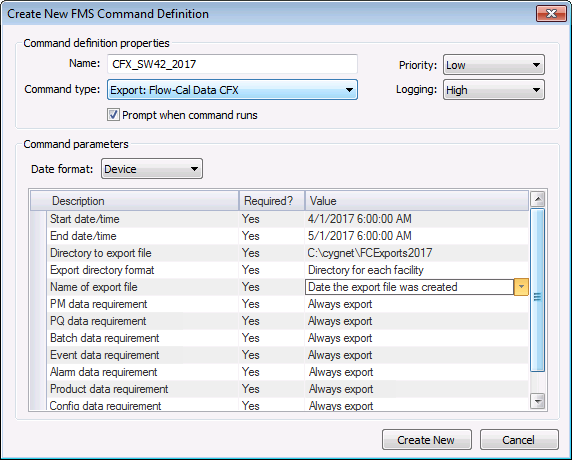
Use the following procedure to configure Flow-Cal Data CFX exports.
To Configure an Export: Flow-Cal Data CFX Command
The following command definition properties apply to Export: Flow-Cal Data CFX commands.
| Property | Description |
|---|---|
|
Name |
Type in a Name for the new command. |
|
Command type |
Select the desired Command type from the drop-down menu. See FMS Commands for more information about available command types. |
|
Priority |
Select a processing queue Priority for the command from the drop-down menu. Options from least to greatest priority are as follows.
Default value is Low level processing queue priority. |
|
Logging |
Select a Logging level for the command results from the drop-down menu. Options are as follows.
Default value is Low level logging when scheduling a command in the MSS. Default value is High level logging when creating or running an ad-hoc command in FMS Explorer. |
|
Prompt when command runs |
Click to select/clear the check box to Prompt when command runs. Selecting this option means you will receive a prompt asking if you want to modify the parameters before the command is executed. |

The following command parameters apply to Export: Flow-Cal Data CFX commands when creating or editing commands via FMS Explorer.
| Description | Value |
|---|---|
|
Date format |
Select the desired time format for data selection, from the drop-down menu. Options are as follows.
Default value is Device time. |
|
Start date/time |
Select the beginning date and time of the range for which to export device records. Click ... to access the Select Date and Time dialog box. Note: It is strongly recommended that the specified time range for the command include only record spans with fully collected data. See Selecting Date and Time for more information. See Note below this table. This parameter is required. |
|
End date/time |
Select the ending date and time of the range for which to export device records. Click ... to access the Select Date and Time dialog box. Note: It is strongly recommended that the specified time range for the command include only record spans with fully collected data. See Selecting Date and Time for more information. See Note below this table. This parameter is required. |
|
Directory to export file |
Enter the directory location to which the file will be exported. Type the directory location for the file into the text box or click ... to access the Browse For Folder dialog box, browse to the directory location, and then click OK. Note: The directory specified is relative to the client computer. This parameter is required. |
|
Export directory format |
Select a file directory format for the .cfx export file, from the options in the drop-down menu. Options are as follows.
This parameter is required. |
|
Name of export file |
Select a file name format for the .cfx export file, from the options in the drop-down menu. Options are as follows.
This parameter is required. |
|
PM data requirement |
For periodic data, select whether to export periodic metering data, from the options in the drop-down menu. Options are as follows.
This parameter is required. |
|
PQ data requirement |
For periodic data, select whether to export periodic quality data, from the options in the drop-down menu. Options are as follows.
This parameter is required. |
|
Batch data requirement |
For batch data, select whether to export batch data, from the options in the drop-down menu. Options are as follows.
This parameter is required. |
|
Event data requirement |
For periodic data, select whether to export event data, from the options in the drop-down menu. Options are as follows.
This parameter is required. |
|
Alarm data requirement |
For periodic data, select whether to export alarm data, from the options in the drop-down menu. Options are as follows.
This parameter is required. |
|
Product data requirement |
Select whether to export product data, from the options in the drop-down menu. Options are as follows.
This parameter is required. |
|
Config data requirement |
For periodic data, select whether to export configuration data, from the options in the drop-down menu. Options are as follows.
Note: Be careful to require Configuration data only if the Node supports history data types that utilize configuration data. If selected for a Node where the supported history types do not utilize configuration data (e.g. Node supports Batch history, but not periodic history) any commands that try to retrieve configuration data will fail since it does not exist. This parameter is required. |
|
File format version |
Select the version of the .cfx file created for the export, from the options in the drop-down menu. Options are as follows.
*7.0.5 is still supported, although 7.0.6 is provided in the CygNet sample file. Click OK. Note: Alternatively, file format version can be configured in the .cdf (command definition file) if desired. This parameter is required. |
|
Data exported flag |
Select whether to flag device records as "exported" in the database, from the options in the drop-down menu. Note: When a "Use flag" option is selected, the Data Exported flag is applied to the entire record, regardless of how many data type(s) are selected for export. Options are as follows.
*Note: When this option is selected, the Data Exported flag is set only for records that contain data, and for which data collection (all supported types) is complete. When exporting partial records (e.g. you are only exporting PM data at this time), it is recommended to use the "Ignore flag" option, preserving the option to flag the record at a later time, when the remaining record data types are exported. This parameter is required. |
Note: When using relative (rather than absolute) date/time, if both the start and end date/time have hour, minute, and second values of 00, or if both are set to midnight, an additional day will be added to the date at the end of the range. This occurs because the service assumes the start of the day for the starting date/time and the end of the day for the ending date/time in these circumstances. Therefore requesting a time range from T to T will yield one day of data, and from T-1 to T will yield two days of data. If only one day of data is desired when using relative date/time, the start and end date/times must therefore be the same. If any of the start or end date/time hour, minute, or second values are specified as a value other than zero (or midnight) however, the range will be used as specified.
*Note: If this option is selected and no associated history data is available (Collection Details value does not equal [blank]), the command will fail and no CFX file will be created. See Collection Details in the CygNet Measurement Concepts topic for more information.
See Managing Node Commands for information about editing or deleting this command.
See Running Node Commands for information about running this command.
If you want to change specific data item mappings, use the following procedure to edit or customize the command definition file (CDF), before executing the Flow-Cal CFX data export command.
Note: When you override a CDF mapping, you generally want to ensure that each newly mapped item is mapped to a field that uses the same unit type as the new item. If you decide to map an item requiring units to a unitless field in the file however, the mapping will still be valid - but the value reported from the device will appear exactly as read, and will not be associated with a unit set. Values are not converted in the file when they are sent to a unitless field.
Optionally add, verify or edit the TimeOrientation value to align timestamps as desired. Options are Leading (all records oriented to the beginning of the record span), Trailing (all records oriented to the end of the record span), or Native (records oriented as configured at the device). Default behavior is Native time orientation.
Note: The Leading or Trailing time orientation override is unable to adjust to handle Daylight Saving Time (DST) changes that originate from the device.
If used, include the TimeOrientation element in the CDF as in the following example.
|
<ExportFlowCal> <FlowCalCommand DisplayIdentifier="8.0.6" Version ="8.0.6" TimeOrientation="Leading"> <Alarms> . . . |
Some items are mapped using a MultiField, that accommodates multiple item mappings. Edit MultiField mappings as desired.
Each MultiField mapping only populates the first Flow-Cal field found (e.g. <DifferentialPressure>), and uses the first valid FMS data item value found (e.g. eFMS_PV_DIFF_PRESSURE) out of all FMS data item enumeration strings listed. Once a valid value is found, that value will be used and processing will continue beyond that MultiField section.
Additionally, if you associate a mapped item in a MultiField with a specific device type (orifice, cone, turbine, etc.), the mapped item will then only be exported if the meter type is correct and the item value is valid.
Note: Problems that arise while processing a command definition file are logged to the Services > FMS log file.
|
|
|

